

Why the Low Temperature Coefficient is Your Biggest ROI Driver in Hot Climates
Posted by SLD Tech Inc on 26th Dec 2025
Introduction
If you are a project engineer, developer, or installer in the Southwest or Southern US, you know the sun is your best friend. But you also know its heat is a big problem. For many years, when we choose solar panels, we look first at the nameplate efficiency. This is the power rating under perfect, laboratory conditions. But in the real world, especially in places like Arizona, Texas, or Nevada, our panels do not work in perfect conditions. They work in very hot conditions. When the temperature rises, the power output of solar panels goes down. This is a fact. The key question is: by how much?
The answer lies in a small but very important number: the temperature coefficient. This is not just a technical term from a datasheet. For your project's financial health, understanding this number is maybe more important than the efficiency percentage. This blog will explain why a better temperature coefficient, like the one found in modern N-type TOPCon panels, is not just a technical improvement. It is a direct driver of your Return on Investment (ROI), especially during the most valuable hours of the year.
What is the Temperature Coefficient? Let's Keep it Simple.
All solar panels lose a little bit of their power when they get hot. The temperature coefficient tells us exactly how much they lose. It is usually written as a percentage per degree Celsius (%/°C).
Think of it like this:
A common, older P-type panel might have a temperature coefficient of -0.40%/°C.
A newer N-type TOPCon panel might have a coefficient of -0.30%/°C.
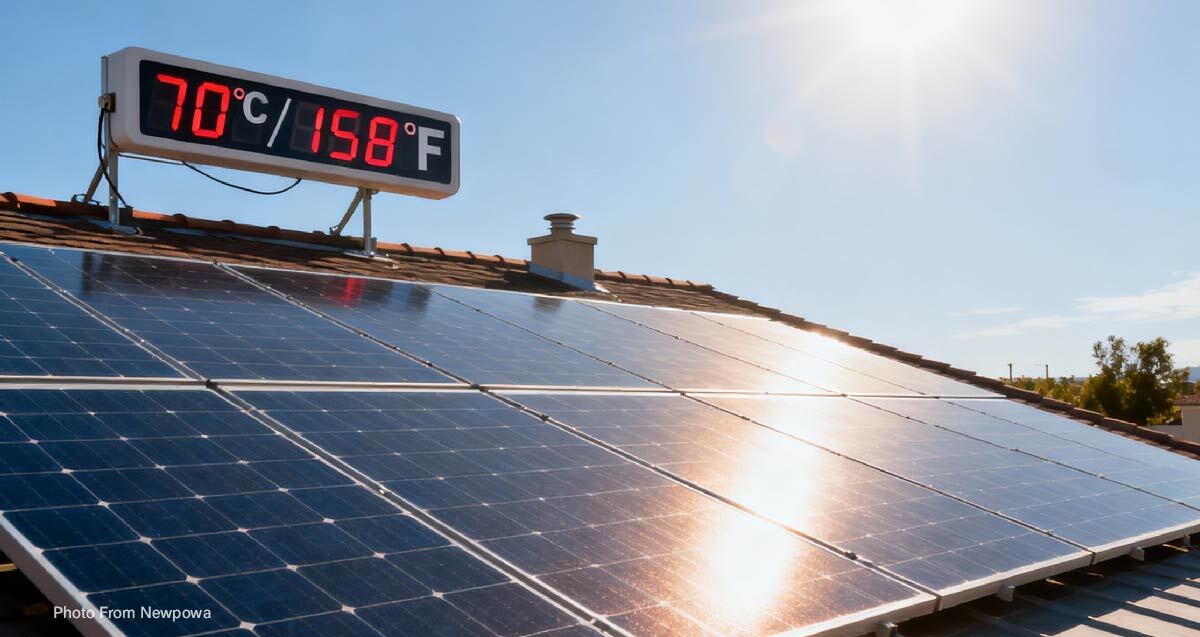
This looks like a small difference, but let's see what it means on a hot day. Imagine a day when the ambient temperature is 35°C (95°F). On a rooftop, the solar panel surface can easily reach 70°C (158°F). The standard test condition for panels is 25°C. So, the panel is 45°C above its rated temperature.
Now, let's calculate the power loss:
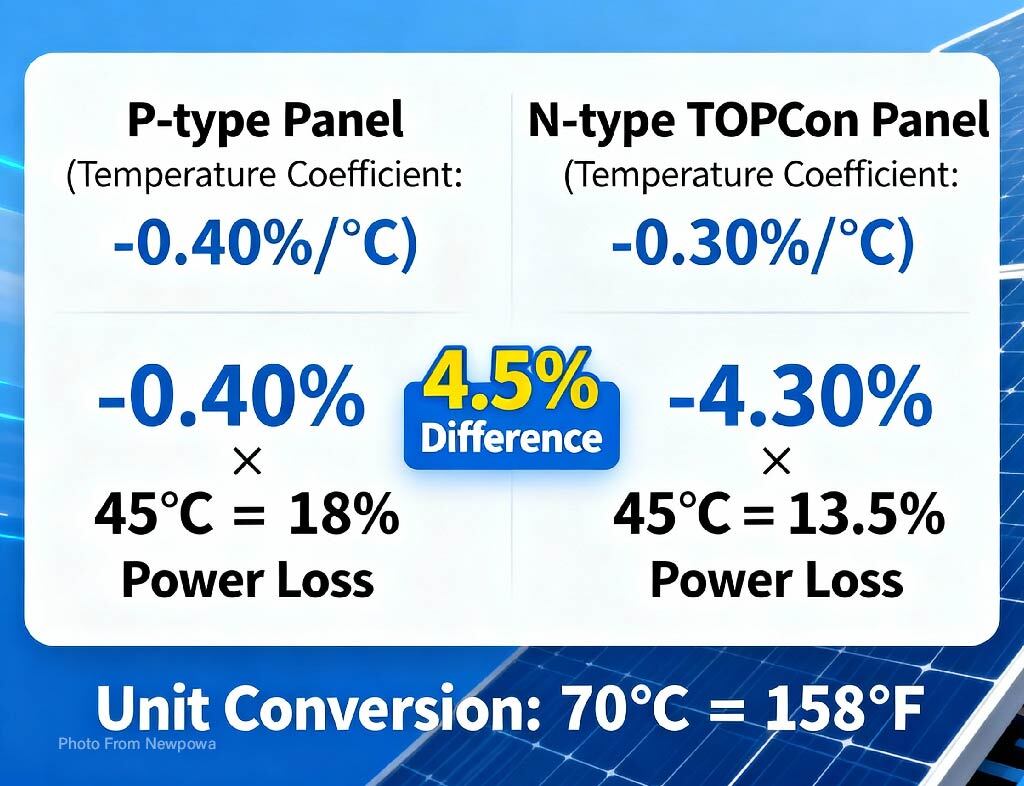
P-type Panel: -0.40%/°C * 45°C = 18% power loss
N-type TOPCon Panel: -0.30%/°C * 45°C = 13.5% power loss
The difference is 4.5%. That means for every 100 kW your system is supposed to produce, the TOPCon system is producing 4.5 kW more than the P-type system at that moment. This is not a theory; this is physics. And this is where the financial story begins.
The Perfect Storm: Peak Heat, Peak Demand, Peak Revenue
Why is this extra power during heatwaves so valuable? Because it happens at the most important time. Summer afternoons are when two things come together:
Highest Temperatures: This is when your panels are at their hottest and suffering the most from temperature-related losses.
Peak Electricity Demand: Everyone is using air conditioning. Factories and businesses are running. The demand for electricity is at its highest.
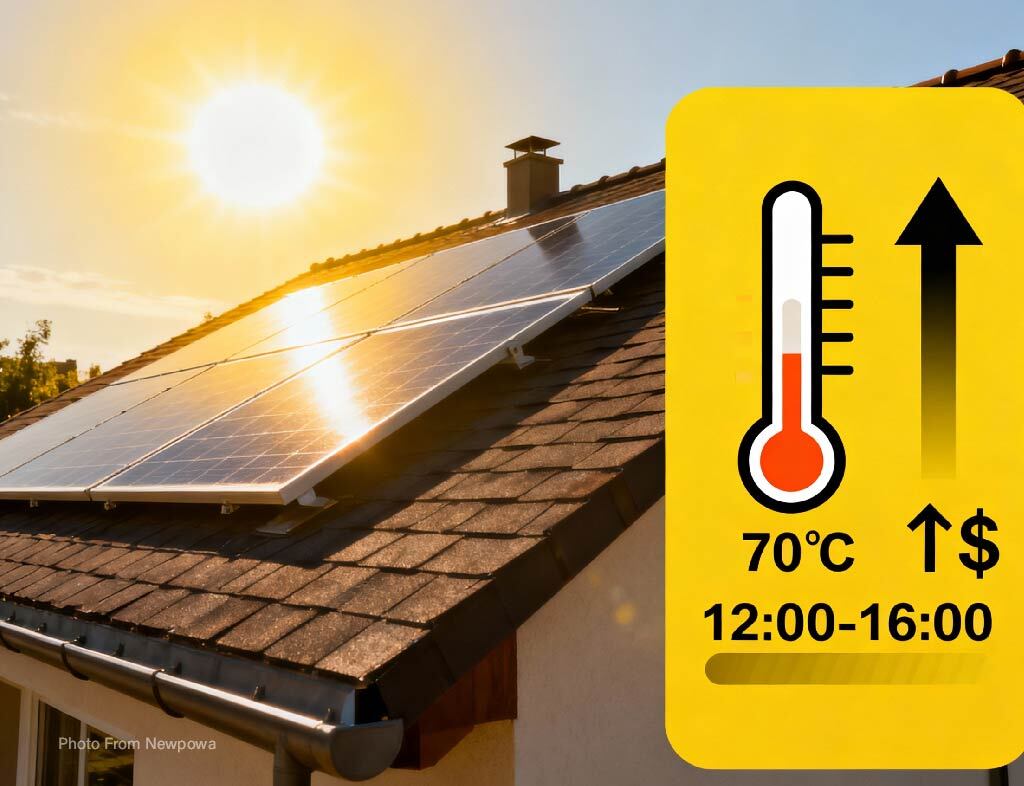
In the world of project economics, this is a perfect storm in a good way for the right technology. Electricity prices during these peak demand hours can be much higher. Some commercial electricity rates have "demand charges" or time-of-use rates that make power very expensive in the afternoon.
So, a system with a better temperature coefficient is not just producing more energy during the summer; it is producing more valuable energy. It is delivering extra kilowatt-hours exactly when the grid needs them most and when your client's electricity bill is the highest. This directly increases the energy yield value of the installation.
Connecting the Dots to Project Economics and ROI
Let's talk about money. As a developer or engineer, your goal is to maximize the financial return of the commercial PV system.
When you model a project's financials, you use a tool to predict energy production over the year. If you only look at the nameplate efficiency, you might see two panels that look similar. But when the model applies the local temperature data, the panel with the better temperature coefficient will show a significantly higher total energy output, particularly in hot climates.
This higher energy output means:
For Developers/Sellers: You can promise a higher, more reliable annual energy production to your client, making your proposal stronger.
For Installers: You can show your client a better payback period and a higher ROI, justifying the potential slightly higher initial cost of advanced panels.
For System Owners: They save more money on their electricity bills every year, especially during the expensive summer months.
Over the 25 to 30-year life of the system, this difference compounds. A 2-5% higher energy production each year, focused in high-cost periods, can add up to a much greater total financial return. It makes the project less risky and more profitable. This is the real meaning of a low temperature coefficient driving ROI.
Conclusion: It's Time to Look Beyond the Data sheet Sticker Price
Choosing the right solar panel is not just about comparing efficiency numbers on a sticker. It is about understanding how that panel will perform in your specific environment. In the hot climates of the American South and Southwest, heat is the single biggest enemy of solar performance.
Therefore, the temperature coefficient is not a minor specification. For your project economics, it is a central feature. A low temperature coefficient, like that of N-type TOP Con technology, is an insurance policy against heat-related power loss. It ensures your system performs when it matters most, turning the hottest, sunniest days into your biggest revenue generators.